
Add a stop, drop the fare: FCF’s Stopover Double Upgrade Strategy and the five-step thinking that turns one Asian trip into two
Start with this: Delta sells Boston to Seoul in Business Class, round-trip, for $10,202.
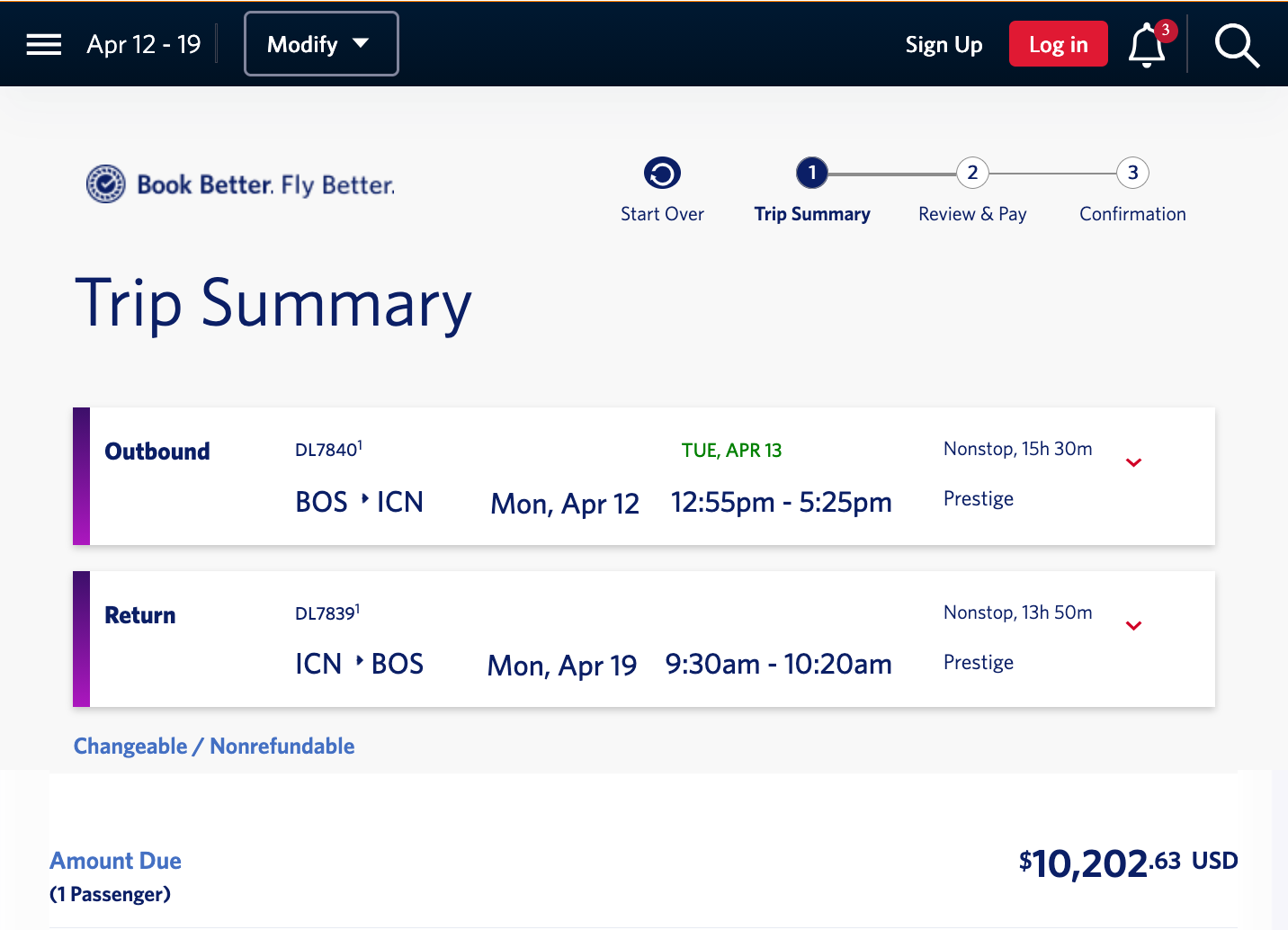
Now ask for something bigger. Boston to Seoul, then Seoul to Singapore, then Singapore home – three flights, two countries, same cabin. The price falls to $4,753.
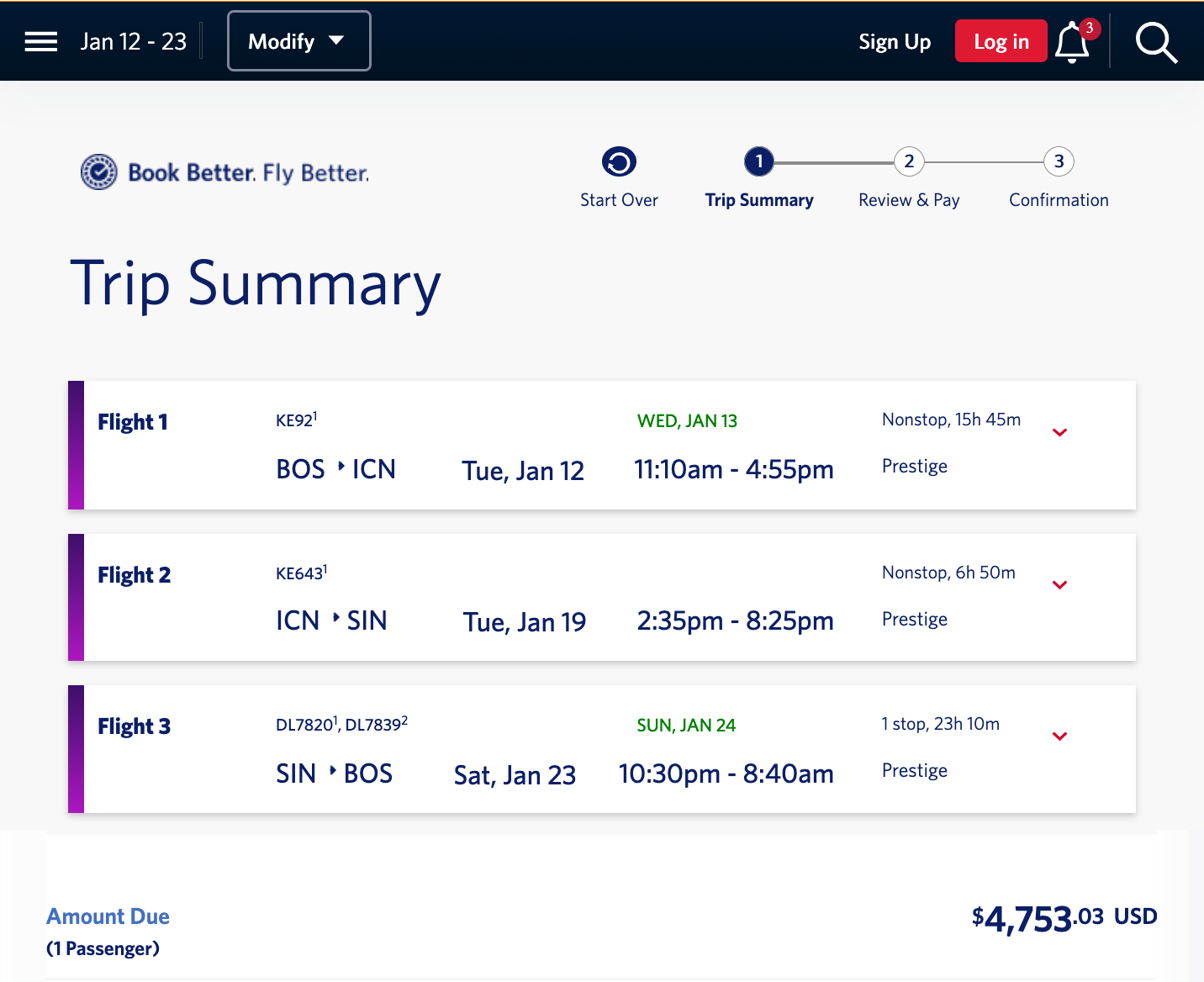
You added a country and subtracted $5,449.
That is not a typo. That is the Stopover Double Upgrade Strategy – SDUS for short.
It has been a while since we checked in on it for Asia. So we just did. The play is alive, and the numbers are better than ever.
Make sense? Let’s go.
Step 1: The Round-Trip Baseline Is a Fantasy Frame
The Upgrade Process begins with a Baseline – seeing where you actually stand. You are informed or uninformed. You are deliberate about knowing your baseline, or you are not.
So goes your baseline, so goes your life. And so goes your fare.
Travel is the perfect laboratory for Upgrade Intelligence. The baselines are printed on the screen, and the trade-offs are priced to the dollar.
Here is the baseline reality: a Business Class round-trip to Asia on the routes we sampled runs $6,500 to nearly $11,000.
But notice how you got them. Every airline website opens on the same screen – round-trip. That screen is a frame, and a frame you did not choose is a fantasy until you test it against reality.
SDUS in Sixty Seconds
Fly from home to an Asian city. Fly from that city to a second Asian city. Fly home from the second city.
Book all three legs as one multi-city ticket, not a round-trip. Because the three-leg ticket prices using a different fare basis, it often costs thousands less than the simple out-and-back.
That is the double upgrade.
Upgrade one: The fare drops.
Upgrade two: A second country appears on your itinerary for free.
The Fresh Fifty-Fivers
We checked hundreds of routes and pulled the best examples for the treasure map below. Sample the summit:
Dallas to Tokyo to Manila and home: $4,940, against a typical round-trip of $10,863. That is $5,923 saved – 55% off – with the Philippines thrown in.
Boston to Seoul to Hanoi and home: $5,386 against $10,102. Vietnam for free, and 47% off.
Los Angeles to Hong Kong to Beijing and home: $5,030 against $7,531. A third off, and two cities in China instead of one.
The full map shows dozens of pairings, and the savings run from a solid 20% to a stunning 55%.
*Remember these are sample fares. Prices vary by length of stay and time of year. Lock it in without commitment. In other words, sit with it.
Business Travelers: This Is Your Bonanza
If you fly to Asia on business, read this twice.
Business fares are the highest fares on the board, which means the same strategy saves you the most money. And the meeting is already paid for – so the second city is pure vacation.
Your company pays for Tokyo. You get Singapore for free.
The meeting becomes the trip, and the trip becomes a week you will remember for the rest of your life.
That is not a discount. That is an upgrade to your whole calendar.
Step 2: One City or One Continent? Rank the Desire
Here is where a travel deal becomes a micro-course in The Upgrade Process.
Step 2 is Desires – naming what you truly want and ranking the weight of each want. Do you want Tokyo, or do you want Asia? Do you want the shortest trip, or the richest one?
Economist Thomas Sowell was right: There are no perfect solutions, only trade-offs. You cannot have everything, so make your trade-offs at the desire level, not the decision level.
Get the ranking right and your decisions get better, easier, faster.
As the philosopher Jonathan Edwards observed, the will always follows the strongest desire – so indecision is never a decision problem.
It is a lack of commitment to a number one desire.
Step 3: The Option Hiding One Tab Over
Desperate people don’t lack options. They lack the intelligence to see them.
This option is literally on the screen. Right next to “Round-trip” sits a tab marked “Multi-city.” Almost nobody clicks it, which is exactly why it still works.
Two rules for loading options like a pro:
- Explore various itineraries. SDUS works best when your first stop is an alliance partner’s home city.
- Book the U.S. carrier, and you will often fly the partner’s metal. Our Delta proof above is Korean Air, on a Delta codeshare, through Korean Air’s own hub.
Beware the backtrack. Booking directly with an Asian carrier can force you through its hub twice, missing other schedule opportunities. The exception is when you connect onward from that hub to a couple of smaller Asian cities – then the geometry works again.
Mix and match. Circle trips using U.S. carriers and their alliance partners – out on one, across on another, home on a third. They often deliver the best routing at the best price.
Play with dates and pairings. Collect 10, shortlist three, book one.
One caveat: We found very little on United / Star Alliance. This is not its game right now.
The Perspective Play: Three Ways to Count the Win
Perspective is a core competency of Upgrade Intelligence, so count this three ways.
The discount perspective: up to 55% off the fare, up to $5,923 back in your pocket.
The experience perspective: That second country is not a layover. It is a week in Singapore or Hanoi you would otherwise have paid $5,000 to $10,000 to reach alone. Framed that way, the “expensive” cabin is the bargain buy.
Step 4: You Don’t Have to Decide Today
You don’t need to decide today. You just need to know your options, because every option you see makes your baseline richer, and everything revolves around your baseline.
Decisions fall out of your greatest desire. Once your number one is named, the itinerary chooses itself.
The Bottom Line
One ticket. Two destinations. Often half the price.
The airline calls that a multi-city itinerary. We call it The Upgrade Formula at 35,000 feet – Baseline tested, Desires ranked, the hidden Option seen, the Decision pre-made, Implementation one tab over.
Add a stop, drop the fare: FCF’s Stopover Double Upgrade Strategy and the five-step thinking that turns one Asian trip into two
Start with this: Delta sells Boston to Seoul in Business Class, round-trip, for $10,202.
Now ask for something bigger. Boston to Seoul, then Seoul to Singapore, then Singapore home – three flights, two countries, same cabin. The price falls to $4,753.
You added a country and subtracted $5,449.
That is not a typo. That is the Stopover Double Upgrade Strategy – SDUS for short.
It has been a while since we checked in on it for Asia. So we just did. The play is alive, and the numbers are better than ever.
Make sense? Let’s go.