
Transcon Business Class fares are daylight robbery. Don’t fight the fares – make them fund your vacation with free flights to the islands.
Two Californians live three doors apart in Manhattan Beach.
Both fly to New York for business. Both take the family to Hawaii twice a year, because that’s what many do that live in California. Same airports. Same seasons.
Same seats up front, because neither of them flies in the back of the plane anymore.
Neighbor One buys his tickets the way the airline taught him to: one round-trip at a time, using the little search box, retail price, every time. Transcon Business Class in October? Typically $3,140+ R/T on American. $3,087+ on Delta. $3,900+ on United.
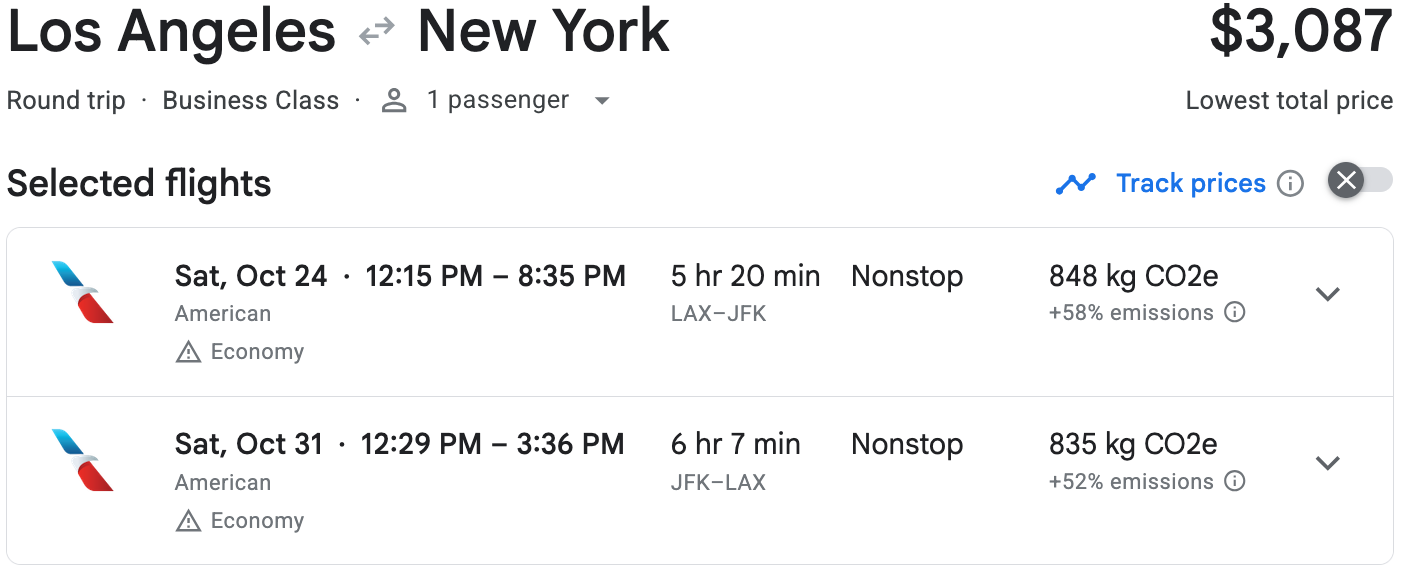
Hawaii in First? ~$1,500 to $2,500 R/T.
That's a total of ~$4,600+ for the four segments, right?
Neighbor Two books the exact same flights – and the airline pays HIM $654 to go to Hawaii.
Not a typo. Not a points scheme. Not a fare war or a flash sale or a fare mistake that dies by lunch.
A published, bookable-today fare structure where adding Hawaii to his New York ticket makes the total ticket CHEAPER.
$304 LESS for all Four Segments

Same flights. Same seats. Different intelligence.
This report is about becoming Neighbor Two.
TRANSCON DAYLIGHT ROBBERY, 2026 EDITION
Let’s name the enemy. Transcontinental Business Class now run higher than ever.
“Fine,” says the loyalty dreamer, “I’ll use my miles.” Good luck. Premium mileage awards on domestic routes have gone from scarce to practically mythological.
Unless you can fly any day, any month, through any connecting city, at any hour – in other words, unless you have no actual life – the award seat you’re imagining doesn’t exist. That’s not a strategy. That’s a fantasy, and fantasy is the most expensive thing a traveler can own.
Here’s the Upgrade Reality check: Dreamers wait for the airline to hand them value. Operators go price it themselves. The dreamer refreshes the award calendar. The operator opens the multi-city search and investigates the fare structure like a detective who already knows somebody’s lying.
And here’s the part that separates Upgrade Intelligence from ordinary bargain hunting: that $3,087 fare – the pain, the insult, the friction – isn’t your obstacle. It’s your raw material. In the Upgrade framework, friction is stored energy. The bigger the fare, the bigger the lever.
You just have to know where to stand.
THE REVERSE HULA LOOPHOLE:
HOW TWO TRIPS, ONE TICKET WORKS
Longtime readers will remember FCF’s original Hula Loophole: East Coast flyers heading to California discovered that adding Hawaii segments to their transcon ticket cost nothing – sometimes less than nothing. Free island trips wrapped inside a trip they were taking anyway. We most recently covered it here for New Yorkers.
This month, the loophole comes home to California – and runs in reverse.
If you live in California and you already (a) fly the transcon and (b) go to Hawaii, you qualify for what we’re calling the 2T1T play: Two Trips, One Ticket. The mechanics take one paragraph:
Instead of buying your New York round-trip and your Hawaii round-trip separately, you book four segments on ONE multi-city ticket: Hawaii back to Los Angeles, Los Angeles to New York, New York back to Los Angeles, then Los Angeles out to Hawaii again.
The ticket covers the tail end of one island trip and the front end of the next – wrapped around your New York business trip like a lei around a very smart neck.
That’s it. No fare codes to memorize, no phone agents to sweet-talk, no status required.
This is the Upgrade Process step called Expand Your Options in its purest form: Before you commit a single dollar, you price the itinerary, not the ticket.
The round-trip search box shows you one option. The multi-city search shows you the market.
Bruce Lee taught us to flow – to stop punching the fare wall and move like water. This special report is the throw. In judo you don’t overpower the opponent; you borrow his momentum and let his own weight do the work.
The $3,087 transcon fare is the opponent charging at you. Step aside, grip the fare structure, and let all that overpriced momentum throw itself right onto a beach in Kauai.
THE NUMBERS: AMERICAN PAYS BEST
We priced the full play – four premium-cabin segments on one ticket – across American, Delta, and United for fall travel, testing countless Hawaiian island combinations for Honolulu (HNL), Maui (OGG), Kauai (LIH), and Kona (KOA).
American: the Unicorn
Every single island combination – all 16 we priced – came back NEGATIVE, meaning you save money to include Hawaii.
Typical transcon: $3,087. The 2T1T fare: roughly $2,632 to $2,786. Your cost for round-trip premium Hawaii: minus $435 to minus $569.
The best of the batch pairs Kauai on both ends (LIH out, LIH back) at – $655.
Read that again: The cheapest way to buy American’s transcon is to make them fly you to Hawaii twice.
Delta: Pick Your Island Carefully
Delta’s loophole opens island by island. Kauai is the sweet spot – LIH on both ends prices out at +$315, and several Kauai pairings run $185 to $196. But wander into the wrong combination – Honolulu-heavy or Kona-heavy routings – and Hawaii suddenly costs you $580 to $880 extra. Still a savings!
The lesson: The loophole isn’t a door, it’s a combination lock. Keep turning the dial.
United: Geography Is Destiny
Out of Los Angeles, United never gets you Hawaii for free – every combination adds $455 to $674. Still a deal, but no free hula at LAX.
But for San Francisco travelers, the whole board flips: minus $38 to minus $213 across multiple pairings, with Kona and Kauai itineraries returning through Honolulu leading the pack.
If you’re a Bay Area flyer, United quietly joins the pay-you-to-go club.
Which brings us to this month’s axiom: Shop the loophole, not the logo.
Brand loyalty is precisely the blindfold that hides these spreads.
The traveler who “always flies Delta” out of habit is paying an $800 premium for a bumper sticker.
The operator who prices all three carriers pockets the difference and drinks his Mai Tai with it.
THE MIND GAME:
WHY MOST FLYERS WILL NEVER SEE THIS
Here’s the uncomfortable truth: Nothing about this play is hidden. There’s no password, no secret desk, no coupon codes. These fares sit in plain sight on Google Flights, available to every human with a laptop. So why does Neighbor One – a smart, successful guy – keep paying retail?
Because the airlines trained him how to ask. The round-trip search box is a cage with a friendly interface. It frames every purchase as a single question – “what does THIS ticket cost?” – when the operator’s question is “what does my YEAR of travel cost?”
Change the question and the entire market rearranges itself in your favor.
This is Options Intelligence, the same principle we’ve applied to mileage awards, seats, and pricing all year: He who prices more combinations wins.
Neighbor Two didn’t work harder. He spent five ten minutes testing multi-city pairings – and those ten minutes are worth $2,000+ or more per year, per traveler, in his household.
Show me another investment paying $200 a minute.
Think of it this way: The retail fare is the menu. The fare structure is the kitchen.
Civilians order off the menu and pay menu prices. Upgrade operators walk into the kitchen, see what the ingredients actually cost, and eat like the chef.
HOW TO RUN THE PLAY
1. Open Google Flights and select Multi-city.
Enter all four segments on one ticket: Hawaii → your California gateway, gateway → New York, New York → gateway, gateway → Hawaii.
2. Test the combinations.
Try different island pairings and dates. As you’ve seen, the spread moves airline by airline, island by island, gateway by gateway, date by date.
3. Plan a little ahead.
Know your New York dates first, then bracket your Hawaii trips around them. That’s the entire price of admission: a little foresight instead of impulse purchases.
4. Know before you buy.
One caveat: these are same-ticket itineraries, so a date change touches the whole ticket. Usually no problem. You just have to pay the fare difference – if any – as usual.
THE DREAMER’S TAX
Back to Manhattan Beach.
At the end of the year, Neighbor One and Neighbor Two have taken the same trips, sat in the same cabins, watched the same sunsets over the same Pacific. The difference between them was never money. Neighbor One had plenty of money – that’s exactly what the airlines were counting on. The difference was a way of seeing.
One saw a price and accepted it. The other saw a structure and investigated it.
Call the gap between them the Dreamer’s Tax: the invisible surcharge levied on everyone who waits for the system to be generous instead of learning how the system actually prices generosity.
The airlines don’t reward loyalty.
They reward literacy.
And here’s the part worth carrying off the plane: My 2T1T thinking doesn’t stop at the jet bridge. Everywhere in life there’s a bundle priced below retail for the person who expands options before committing – in negotiations, in hiring, in real estate, in every market where the incurious pay the sticker price.
Travel is just the practice mat. The reflex you build here – price the itinerary, not the ticket – is the same reflex that upgrades everything else in life.
Your assignment this week: run one multi-city price test on a trip you were going to take anyway. Five minutes.
When your own Impossible Invoice comes back in negative territory, send it to us. Somewhere over the Pacific, in seat 2A, a First Class Flyer is sipping a Mai Tai the airline paid for.
There’s no reason it shouldn’t be you.
Transcon Business Class fares are daylight robbery. Don’t fight the fares – make them fund your vacation with free flights to the islands.
Two Californians live three doors apart in Manhattan Beach.
Both fly to New York for business. Both take the family to Hawaii twice a year, because that’s what many do that live in California. Same airports. Same seasons.
Same seats up front, because neither of them flies in the back of the plane anymore.
Neighbor One buys his tickets the way the airline taught him to: one round-trip at a time, using the little search box, retail price, every time. Transcon Business Class in October? Typically $3,087+ R/T on American. $3,900+ on Delta. $3,140+ on United.
Hawaii in First? ~$1,500 to $2,500 R/T.
That's a total of ~$4,600+ for the four segments, right?
Neighbor Two books the exact same flights – and the airline pays HIM $304 to go to Hawaii.
Not a typo. Not a points scheme. Not a fare war or a flash sale or a fare mistake that dies by lunch.
A published, bookable-today fare structure where adding Hawaii to his New York ticket makes the total ticket CHEAPER.
$304 LESS for all Four Segments
Same flights. Same seats. Different intelligence.
This report is about becoming Neighbor Two.