
In an Emergency, FCF’s Fare Department Puts Out Those High Fare Fires…
We’re currently in the midst of a perfect storm for high fares. Travel is picking up like crazy after the global lockdowns – flights are full, fuel prices are high, oh, and there’s that other thing everyone keeps talking about: inflation. But, remember all those deals we told you about when fares were low here, here, here and here? And how we said, “get ‘em quick”? Well did you? If so, awesome. Our work wasn’t in vain. But if you didn’t book them, well then read on.
So before you call 911 for emergency assistance, here are some preventive measures to help you circumvent all those blazing high fares and douse the fires with cool deals, instead.
Inflation Frustration
As you’ve seen, many fares are higher now than they’ve been over the last several years on major airlines such as American, Air France, British Airways, Delta, Emirates, Iberia, KLM, Lufthansa, SAS, Singapore, SWISS, United and Virgin Atlantic to most destinations. But you can see similar forces at work in your local grocery store, right? Food prices have skyrocketed. Then there’s the price of gas. Airlines need fuel too – lots of it. Many say inflation is at a 40-year high.
Fare inflation typically happens when demand outpaces supply, so I guess there’s some joy in seeing demand for travel after Lockdown, only now airlines aren’t able to ramp up supply fast enough. Let’s look at all this in the context of how fares are trending.
To this end, here’s a special FCF survey of recent observations we’ve made that’ll help you start thinking outside your traditional fare box. Think of them as your ladder to fare safety. And if you don’t spot the perfect deal, try to apply the general airline, route, and/or date trends to your particular trip to find your deal.
Business Class
High- and Low-Fare
Observations
Delta Nonstops: Detroit to Amsterdam, Frankfurt, Munich and Paris $3,408+; New York-Milan starts from $3,296; Rome from $3,759; and Venice from $3,293 if you can time it right. Lock yourself into the wrong dates and/or routes and you’re looking at Atlanta-Athens for $5,901 or Venice at $5,193.
JetBlue Comes to Town: Boston-London/Gatwick has a couple of days at $2,116 in September, otherwise $3,766+; to London/Heathrow $2,964 a couple days in August otherwise $3,814+. Compare that to $2,364 on American, British Airways, Delta, and United for travel September to March on Tuesday through Friday, otherwise $3,564+. So much for JetBlue’s transatlantic entrance bringing fares down.
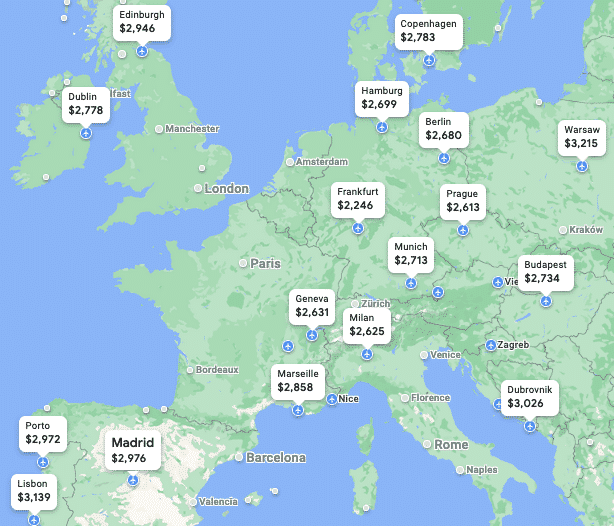
Singapore Airlines: If you’re flying to or via Frankfurt, Singapore offers $2,248 Business Class fares from New York nonstop for travel in August departing Mondays through Thursdays. Choosing their superior seat seems like a no-brainer if you can make the scheduling work. Also notice that there are many connecting routes with Star Alliance partners under $3,000, as you can see here:
Emirates Fare Scene: Scattered dates available from September to December for New York-Milan from $3,926 otherwise brace yourself for $6,000 to $11,000 summer fares. Get Newark-Athens from September to March from $4,214, otherwise fares are much higher, even as high as $12,600.
One-Stop Leaders: American and British Airways offer more low one-stop Business Class fares, while Delta offers the least.
Low Fares on TAP: Business Class New York-Milan via Lisbon for $2,162 for travel September to March. Miami-Milan or Rome for travel October to March on TAP goes for $1,732 versus $2,479 on Air France, American, British Airways, Iberia, and Lufthansa for travel May to March.
Other good TAP fares include San Francisco to Lisbon from $2,603, New York-Madrid via Lisbon for $2,134 for travel from September to March, and New York to London from $1,462 from September to October, November, and January to March. Lowest fares if you’re flexible:

Low-Cost Portugal: New York-Porto is $2,250 on SWISS via Frankfurt for travel July to March on Sundays through Thursdays versus TAP via Lisbon from $1,669 June, July, and September to March.
Alitalia’s newly rebranded ITA: Has a mixed bag of Business Class nonstop fares to Europe: New York-Milan from $3,200 to $3,497 and New York-Rome from $3,300 to $3,760, while Boston-Rome starts from $3,110 and Miami-Rome from $2,464, October through March.
Iberia: New York-Madrid for $2,713 for travel September to March mid-week only, otherwise $3,493. The lowest fare from Chicago and Miami is $3,501.
More High-Fare Nonstop / Low-Fare Connecting Routes: Boston-Edinburgh ranges from $3,421 to $15,100 on Delta nonstop, June to September versus British Airways via London from $2,482 for travel September to March on Tuesday, Wednesday, and Thursday.
Low & High Fares to Greek Isles: Washington, DC-Santorini or Mykonos via London on British Airways is $2,420, May to October, versus Lufthansa via Frankfurt from $4,324 for travel August to October.
Paris: Miami-Paris non-stop on Air France $3,486 a few dates in July and August, otherwise $3,700-$4,600+; New York-Paris via Dublin on Aer Lingus is $2,998, August to March versus United’s nonstop from $6,829; San Francisco-Paris nonstop on Air France and United $3,379 in August, otherwise $4,200+.
Playing the Star Alliance: Washington, DC-Athens nonstop on United ranges from 4,124 to $17,000(!) versus one stop on Air Canada, Air France, American, British Airways, Brussels, Delta, Lufthansa and United for $2,377.
Nonstop Hub Hogs: Atlanta-London for $3,564 on Delta or British Airways; Dallas-Paris for $3,987 or Rome for $4,009 on American; Chicago to Vienna $4,106 Austrian Airlines; Houston-Frankfurt or Munich on Lufthansa and United for $4,377; Washington, DC to Zurich $4,046 to $6,696.
West Coast High-Fare Nonstops: Los Angeles-Vienna for $5,384 on Austrian versus Lufthansa via Frankfurt for $4,008; San Francisco-London for $3,564 on United or $4,164 on British Airways; Seattle-London on Delta for $3,564; Phoenix-London for $3,964 on American and British Airways.
West Coast Lower-Fare Nonstops: Finnair’s Seattle-Helsinki for $2,911 for travel on Wednesdays July through October and San Francisco-Copenhagen has a short travel window in August on SAS for $2,918.
High Fare-Beater Insights
Given how easy it is to run into a $3,500 to $5,500 Business Class fare to Europe, here’s a list of strategies to improve your odds of snagging one.
- Stay on top of the best flash fares. Save money and time with FCF’s flash fares.
- With the elimination of change fees, the ability to upgrade continues even after you have your ticket in hand, as covered in depth here and here. This also works for you First Class flyers as mentioned here and here.
- A fare hold means just that — you can freeze a good deal in time to see if the dates work out for a trip. You can buy several tickets on different days and on different airlines to see what works best, without the worry of cancellation fees. More here: Hold Your Fare, Not Your Breath: A Look at 2022 Fare Lock-In Policies
- Many airlines are currently offering “travel fee waivers,” including for award flights. That means it won’t cost you anything to cancel or change your ticket. Read more about it here.
- When booking, check for refundable fares for the same cost or a little more in case you want to make a change later. FCF has written more on that here.
- Save hundreds of dollars (and sometimes even thousands) on many premium fares on 26 airlines, thanks to Amex’s International Airline Program (IAP).
- A Star Alliance strategy we call the Destination Double Down works for those traveling to Asia who’d like to visit Europe for free or even less than free. Or, for those heading to Europe who would like to visit Asia for free. FCF calls it the “Destination Double Down,” because it gets you to an extra world-class destination for barely any additional cost.
- It’s a similar story with Oneworld member Finnair. From their U.S. departure cities – Chicago, Dallas, Los Angeles, and New York — you can fly to Asia with a stop in Helsinki for half the price (more or less) of a nonstop from the U.S. to Asia. FCF has the story here.
- If you’re on a budget, why would you pay a lot for a lie-flat seat when you’ll be working on your laptop or watching a movie? Don’t select the default option of flying both ways in the same cabin when you can maximize your value on long-haul flights. FCF has covered this strategy using normal published fares, here, here, and here, and found opportunities by mixing cabins with American, Delta, and United to Europe here.
- If you dream, then plan, then buy your ticket, you’re doing it wrong. See how a world of opportunity opens up when you think laterally, as evidenced right here in this special report.
- So much of travel involves default thinking, and that’s just how the airlines like it. One of FCF’s foundational pillars is to be an “opportunity traveler.” We show you why and we show you how right here.
- FCF’s Fishing for Fares special report shows you how to reel in Business Class return fares.
So, don’t let those fiery high fares scare you away and burn up your travel dreams. You can escape the blaze with cool deals — and still live your best travel life.
In an Emergency, FCF’s Fare Department Puts Out Those High Fare Fires…
We’re currently in the midst of a perfect storm for high fares. Travel is picking up like crazy after the global lockdowns – flights are full, fuel prices are high, oh, and there’s that other thing everyone keeps talking about: inflation. But, remember all those deals we told you about when fares were low here, here, here and here? And how we said, “get ‘em quick”? Well did you? If so, awesome. Our work wasn’t in vain. But if you didn’t book them, well then read on.
So before you call 911 for emergency assistance, here are some preventive measures to help you circumvent all those blazing high fares and douse the fires with cool deals, instead.
Inflation Frustration
As you’ve seen, many fares are higher now than they’ve been over the last several years on major airlines such as American, Air France, British Airways, Delta, Emirates, Iberia, KLM, Lufthansa, SAS, Singapore, SWISS, United and Virgin Atlantic to most destinations. But you can see similar forces at work in your local grocery store, right? Food prices have skyrocketed. Then there’s the price of gas....