
Volatile fare pricing, which has been around for a long time, is now turning up in the form of refundable fares.
Free-Range Flex Fares
The lockdown brought a host of new airline incentives with it. The airlines started offering free cancellations and changes like never before. While that is great — and understandable — there’s often a catch when airlines are being generous or testing out new offerings. So, we thought we’d dive deeper into the postmodern world of flexible fares, and outline how to navigate them after one of our eagle-eyed senior analysts unexpectedly spotted something new.
Let’s take a step back for a moment. Free cancellations in the form of a voucher or a trip credit are usually valid for 12 to 36 months (more information here). Although you have that year+ up your sleeve, “voucher” or “trip credit” means you don’t get any cash back in your hands, pockets, or otherwise.
As we were working on this special report, we discovered several things:
- New flexibility policies are popping up on airline websites like little buds in spring.
- Opportunities vary for the same flight from one airline to the next.
- Everything is changing on a day-to-day basis. Blink and you could miss a golden opportunity.
- Gold medal for being first goes to American. Delta and United have quickly followed suit.
Given these trends, it’s important to note that much of this may have changed by the time you search for yourself – things are that volatile right now. So, use this report to be aware of the variables you should look out for if you care about flexibility and refundability. That way, you can compare website offers for the same routes on different sites.

A Tale of Two Clicks
On some airline websites, you can see what the refundable fare is, take control of your change and cancellation destiny, and net some huge savings over traditional, exorbitantly-priced refundable fares. All in just a click or two.
Note that new “flexible fares” are making the cancel option a lot friendlier, easier, and certainly a lot cheaper than normal refundable fares.
Most airlines, such as American, Delta, and many others, allow you to choose while selecting your flights. At that point, you select “Lowest Fare” or “Flexible.”
On the other hand, British Airways and United, for example, require you to choose the option to book a refundable fare when entering your flight data, so it can easily be overlooked, if not expensive.
Why Pay Extra for a Refundable Fare?
- If you don’t fly too often. It’s good insurance if you might not be able to use a voucher within the next 12 to 36 months.
- There’s no buyer’s remorse. It makes changing or canceling your travel plans much more palatable.
- If you’re a traveler with an unpredictable schedule.
- If you’re traveling for business and the client is covering the cost, or not.
- When you’re simply unsure. You can potentially score a great sale now for an extra $400 to save $1,000 in the future
Flex Fares in Action:
American’s Flexible Fares Turn Up the Volatility Altimeter
The screenshot below shows American Airlines’ New York-London route, which offers flexible fares right now. It shows how you can lock in a refundable fare for just $400 more than a non-refundable fare. That’s $400 extra for a whole lot more peace-of-mind for many in 2021. For context, refundable fares have historically run 2X to 4X more.
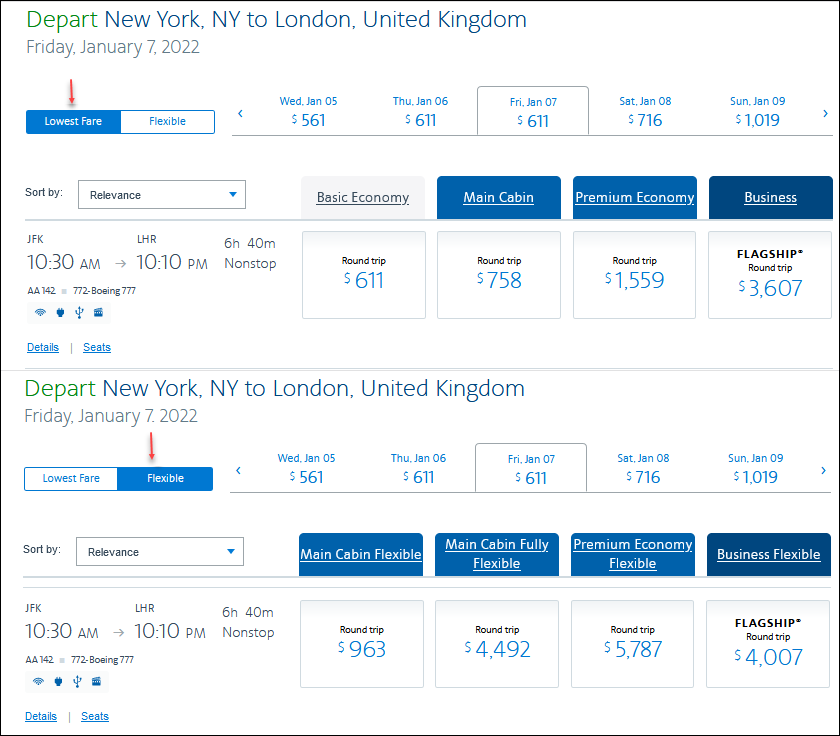
American’s flexible fare for their partner Finnair offers a flexible fare difference of just $200 on their New York-Helsinki route.
A Tale of Two Sites
Compare booking with American and British Airways for the same New York-London Business Class flight. On American, it costs $3,080 non-refundable, while the refundable option is $3,480.
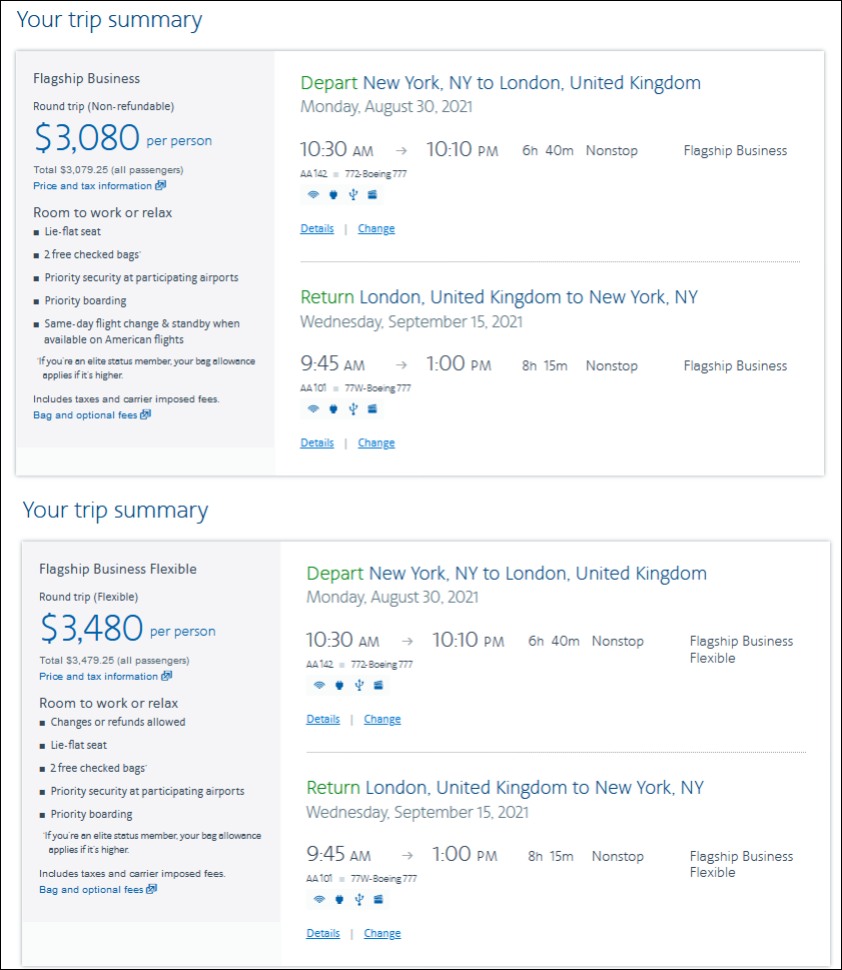
But on BritishAirways.com, it costs $3,079 for the non-refundable option, while the refundable option on American is $3,480. Compare that to British Airways’ refundable price: a whopping $15,929.
A Tale of One Benjamin
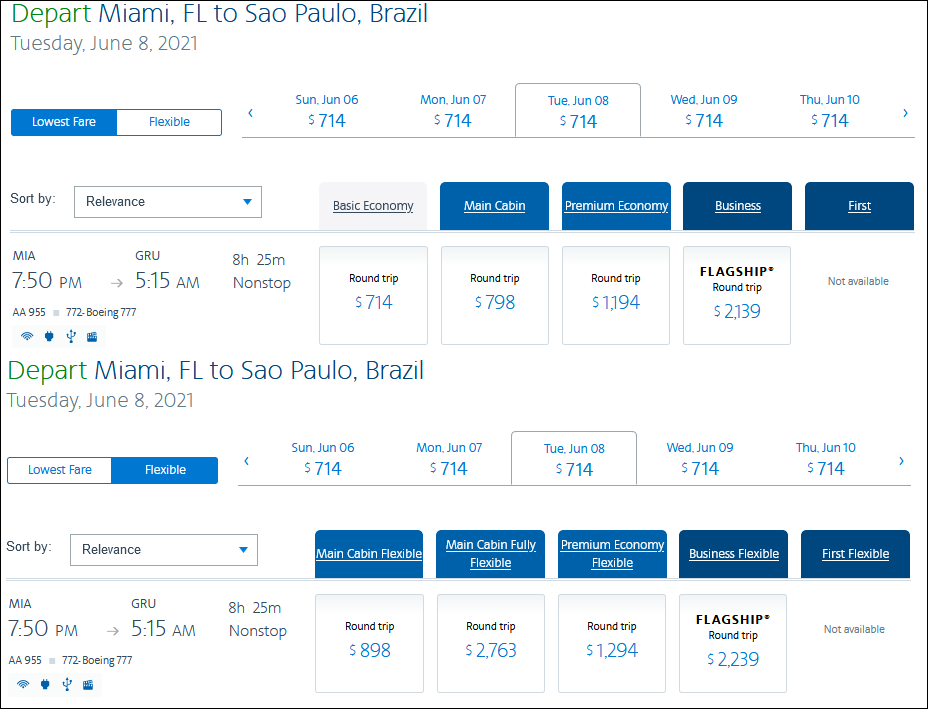
Some routes offer a low flexible fare option. American’s Miami-São Paulo lowest Business Class fare is $2,139 while its flexible fare is only $100 more at $2,239 – now that’s a wise deal.
And keep in mind, that’s only one set of dates. Flex fares are clearly still in the experimental phase. We don’t know exactly where and when they work. That’d take about 7,000,000,000 searches, which we don’t have time for. Will they end when the lockdown does? Probably.
The News Isn’t All Good
Keep in mind that some routes offer low flexible fares and some do not. The lowest American Airlines Transcon fares are $1,297 while the lowest flexible fare is a whopping $6,889.
The summary below shows a snapshot of examples of fare differences for some destinations. Obviously, there will be wild variability across more routes, dates, and airlines. It’s as moveable as an artichoke ravioli on AA142 to Heathrow.
Putting the Fun Back into Refundable.
More on What We’re Seeing
And subject to change by the time you read this.
Europe
Oneworld
- American offers low flexible fares for its own flights and most partners, ranging from an additional $200 to $400. British Airways offers low flex fares on partner Finnair for an additional $450.
- British Airways and Iberia both offer flexible fares at a very high price for their own flights as well as their partner American.
- Finnair offers low flexible fares on American, British Airways ($75 extra fee), and Iberia for an incremental $400.
SkyTeam
- Delta offers low flexible fares on many of their own flights and partner Air France, KLM, and Virgin flights.
- Air France, KLM, Alitalia, and Virgin do not offer low flexible fares on their own flights or partners.
Star
- United offers low flexible fares for partners Air Canada, Lufthansa, and SWISS starting from $400 extra.
- LOT offers semi-flex and full flex; better to buy semi flex as the $900 fee is $100 less than full flex.
- Air Canada offers lowest fares for a fee of approximately $500; it does not offer low flexible fares on partner flights online.
- TAP offers low flexible fares for their own flights for about $180 extra, but not for partners.
Domestic
Short/Medium Haul:
- American does not offer low flexible fares on routes such as Philadelphia to Miami or New York to Dallas.
- Delta offers low flexible fares on routes such as Seattle to Orlando for an extra $200. Delta does not offer low flexible fares on routes such as Seattle to Atlanta.
- United offers flexible fares on routes like Houston to San Francisco for an incremental $400.
Transcon:
- Low flexible fares were not found on American, Delta, or United.
Hawaii:
- No carriers were found to offer low flexible fares.
Caribbean:
- American offers low flexible fares to some destinations such as Miami to San Juan and St. Thomas for an extra $50.
- Delta offers low flexible fares to some destinations such as New York to San Juan for $200 extra.
- United has flexible fares on routes such as Houston to St. Thomas for an extra $425.
South America:
- American offers low flexible fares for as low as $100 extra on some routes.
- Delta and United do not.
South Pacific:
- American’s flexible fares start at $725 extra for American and Qantas flights.
- Air Canada offers refunds on the lowest flexible fare for an extra $400 for their own flights but not for partner flights.
- No low flexible fares were found on Delta, Qantas, or United, for their own flights or partner flights. Beware of Qantas flexible fares, which offer credit only in the form of a voucher.
Middle East:
- Emirates has four fare types. The difference between the lowest non-refundable and the lowest refundable is $268 for New York-Dubai in Business Class plus a $400 fee. Qatar offers a refund on the lowest fares for $590 New York-Doha.
Asia:
- American fares are so high that both the lowest and the flexible fares are the same and are all refundable for American, Japan, and Cathay Pacific flights.
- Cathay Pacific offers cancellation for $500 on the lowest fares (which are high). Singapore Airlines offers a mid-level flexible fare for about $1,600 plus a $200 fee.
Volatile fare pricing, which has been around for a long time, is now turning up in the form of refundable fares.
Free-Range Flex Fares
The lockdown brought a host of new airline incentives with it. The airlines started offering free cancellations and changes like never before. While that is great — and understandable — there’s often a catch when airlines are being generous or testing out new offerings. So, we thought we’d dive deeper into the postmodern world of flexible fares, and outline how to navigate them after one of our eagle-eyed senior analysts unexpectedly spotted something new.
Let’s take a step back for a moment. Free cancellations in the form of a voucher or a trip credit are usually valid for 12 to 36 months (more information here). Although you have that year+ up your sleeve, “voucher” or “trip credit” means you don’t get any cash back in your hands, pockets, or otherwise.
As we were working on this special report, we discovered several things:
- New flexibility policies are popping up on airline websites like little buds in spring.
- Opportunities vary for the same flight from one airline to the next.
- Everything is changing on a day-to-day basis. Blink and you could miss a...